

Years ago, I trapped myself in a grueling cycle of consuming 900 calories a day, chasing fast scale drops that always rebounded within six weeks. True fat loss only happened when I stopped treating my body like an enemy and implemented sustainable weight management strategies without crash dieting.
Severe restriction fails because human physiology treats extreme deprivation as impending starvation. When you slash your food intake drastically, your biological survival machinery fights back. If you want results that last years rather than days, you must work alongside your hormones, muscle mass, and daily behavioral psychology.
I learned the hard way that brute-force willpower cannot outmatch millions of years of evolutionary programming. Rapid weight loss programs force your endocrine system to sound an internal alarm.
When you subject your body to a severe deficit, circulating leptin—the hormone signaling fullness—crashes. Simultaneously, your stomach ramps up ghrelin secretion, intensifying biological hunger signals. Peer-reviewed research compiled by the National Institutes of Health proves that these hormonal disruptions persist long after a crash diet ends. During my most extreme cuts, this hormonal imbalance caused relentless cravings and cognitive brain fog. A moderate, consistent deficit preserves steady hormone output, keeping cravings manageable.
Severe restriction forces your body to break down active skeletal muscle for fuel. Muscle tissue demands significant calories simply to exist. As your lean mass drops, your resting metabolic rate plummets alongside it. You end up burning fewer calories at rest, making eventual weight regain almost inevitable. Sustainable systems protect this tissue at all costs.
Replacing desperate dietary extremes with systematic protocols changed my physique and my daily health markers. Here are the core strategies that delivered lasting results.

I stopped calculating what to eliminate and focused on what to crowd onto my plate. Prioritizing nutrient-dense whole foods stabilizes postprandial glucose swings and extends gastric emptying.
According to research from the Harvard T.H. Chan School of Public Health, prioritizing food quality over strict energy deprivation consistently delivers superior metabolic outcomes. I construct every plate around a palm-sized cut of lean poultry, fish, or tofu paired with two fistfuls of fibrous greens.
Putting these nutritional principles into practice becomes easier when you have a variety of balanced meals to choose from. Explore these balanced meal ideas for weight management for practical combinations that make nutritious eating easier to maintain without relying on restrictive diets.

Cardio cannot replace heavy resistance training when managing body composition. When I ran five miles daily on empty calories, my body cannibalized muscle and retained stubborn body fat.
Lifting weights 3 to 4 days weekly sends an unequivocal signal to your central nervous system: skeletal muscle is non-negotiable for survival. Even during a conservative caloric deficit, demanding compound lifts—squats, Romanian deadlifts, overhead presses—force your system to source energy almost exclusively from adipose tissue stores.

Non-Exercise Activity Thermogenesis (NEAT) accounts for far more total daily energy expenditure than a 45-minute spin class. The Mayo Clinic highlights NEAT as a primary differentiator between individuals who maintain weight loss long-term and those who experience weight cycling.
When crash dieting, your body instinctively reduces spontaneous movement; you sit more, fidget less, and lounge during free hours. To counter this subconscious drop:
This consistent baseline expenditure keeps your daily energy output high without triggering ravenous post-workout hunger spikes.
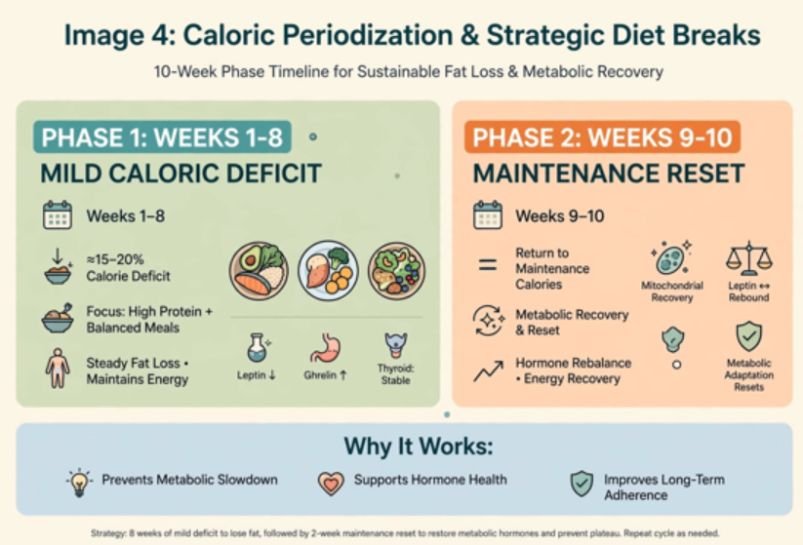
Perpetual restriction guarantees metabolic slowdown and psychological burnout. The Centers for Disease Control and Prevention recommend losing no more than 1 to 2 pounds per week for lasting results. I implement this through structured 10-week phases:
Weeks 1–8: Conservative energy deficit (300–400 kcal below maintenance)
Weeks 9–10: Maintenance calorie reset (elevated carbohydrates, equal protein)
During my own 10-week testing protocol, bringing carbohydrates back to maintenance during weeks 9 and 10 restored depressed thyroid hormones (T3), dropped elevated salivary cortisol levels, and revitalized gym strength. When I returned to the mild deficit in week 11, fat loss resumed smoothly without a plateau.
Stepping on the scale every morning can wreck your consistency if you do not understand fluid balance. Cortisol spikes, muscle inflammation from hard training, glycogen storage, and hormonal shifts make the scale jump wildly.
You must learn to stop weight fluctuations day to day from dictating your emotional state. Instead of reacting to daily highs and lows, collect your weight three mornings each week under identical conditions, calculate the weekly average, and compare month-over-month trends.
Pair those numbers with waist-to-hip tape measurements, progress photographs taken in natural light, and gym performance logs to track weight loss progress accurately. If your waist circumference shrinks and your barbell lifts climb while the scale stays flat, you are burning fat and gaining muscle simultaneously.
A safe, sustainable rate of fat loss is 0.5% to 1% of your total body weight per week.
No, complex carbohydrates fuel high-intensity training and spare lean muscle when total calories remain managed.
Take a two-week maintenance diet break to reduce systemic cortisol and reset your metabolic expenditure.
You can lose weight, but up to 30% of that loss will come from metabolically active muscle tissue.
Starvation diets deliver quick illusions followed by lasting metabolic frustration. Stop trading long-term hormonal health for short-lived changes on a bathroom scale. Build your daily plate around 30 grams of protein and leafy greens, lift weights three times this week, and hit 8,000 daily steps. Consistency outlasts intensity every single time.













2 thoughts on “Sustainable Weight Management Strategies Without Crash Dieting”