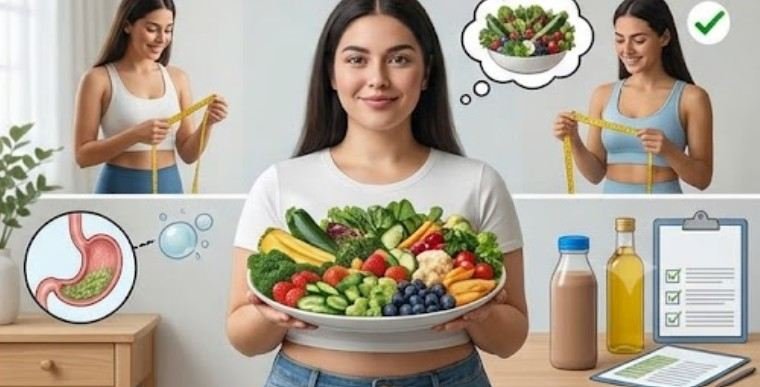
A large, satisfying meal can sometimes contain fewer calories than a snack-sized portion of processed food. The difference is often food volume, not portion size alone. That’s the idea behind volume eating for weight loss explained: choosing foods that take up more space on your plate while providing fewer calories per bite.
Instead of shrinking every meal, this approach emphasizes vegetables, fruits, lean proteins, and fiber-rich ingredients. You can enjoy generous portions while managing your calorie intake.
But eating more food doesn’t automatically mean losing weight. Understanding how food volume, energy density, and hunger interact makes this strategy far more effective.
Volume eating is a dietary approach that emphasizes foods with low energy density, meaning they provide relatively few calories for their weight or volume.
Foods rich in water and fiber are particularly useful because they add bulk without dramatically increasing calories.
Consider two snacks: a small handful of potato chips and a large bowl of sliced strawberries. The strawberries generally provide greater physical volume for a similar or smaller calorie contribution.
According to the Centers for Disease Control and Prevention, replacing calorie-dense ingredients with fruits and vegetables can reduce meal calories without reducing the amount of food consumed.
The important word is replacing. Simply adding vegetables to an unchanged meal may increase total calories rather than decrease them.
Your stomach responds to food volume through physical stretching, while your digestive system and brain communicate through appetite-regulating signals.
Two characteristics make certain foods particularly satisfying:
Protein also contributes to satiety, making chicken, tofu, fish, eggs, and Greek yogurt valuable additions.
The American Heart Association explains that high-fiber foods often require more chewing and can help people feel satisfied while consuming fewer calories.
However, hunger involves more than stomach size. Hormones, meal composition, sleep, and eating patterns also influence appetite.

The relationship between energy density and calorie intake has been examined in controlled research. A 2022 systematic review and meta-analysis published in Obesity Reviews evaluated 31 experimental studies examining how changing food energy density affected daily calorie consumption.
Researchers found that serving lower-energy-density foods substantially reduced daily energy intake. Evidence for greater weight loss was promising but less conclusive.
The findings suggest that lower-calorie-density meals can help people reduce energy consumption without relying exclusively on smaller portions. Research also emphasizes overall dietary quality.
Harvard T.H. Chan School of Public Health recommends building balanced meals around vegetables, fruits, whole grains, healthy proteins, and appropriate amounts of healthy oils.
This distinction matters: successful volume eating involves nutritional balance, not simply maximizing the amount of food consumed.
Food choices that can increase meal size without excessively increasing calories
Broccoli, cauliflower, zucchini, cabbage, spinach, cucumbers, and leafy greens provide fiber, water, vitamins, and minerals.
Strawberries, watermelon, cantaloupe, oranges, apples, and blueberries provide sweetness, hydration, and beneficial nutrients.
Skinless chicken, fish, tofu, lentils, eggs, cottage cheese, and plain Greek yogurt improve meal satisfaction.
Air-popped popcorn, vegetable broth soups, and raw vegetables with hummus offer satisfying alternatives to many packaged snacks.
For added variety, explore an anti-inflammatory diet food list featuring vegetables, fruits, legumes, and other nutrient-rich ingredients.

One practical way to apply volume eating is to use a balanced plate rather than measuring every ingredient.
Illustrative balanced-plate proportions; include healthy fats in moderate amounts.
Add a modest amount of olive oil, avocado, nuts, or seeds to support nutritional balance.
This arrangement helps maintain substantial portions while supplying protein, carbohydrates, and essential fats.
Add mushrooms and spinach to scrambled eggs, shredded zucchini to pasta sauce, or cauliflower to rice dishes. These additions increase meal volume while supplying useful nutrients.
Try combining regular pasta with zucchini noodles rather than eliminating pasta completely. You retain familiar flavors and textures while lowering the overall energy density.
Replace some packaged snack occasions with air-popped popcorn, fruit, or plain Greek yogurt with berries. Portion sizes still matter, especially when adding nuts, oils, or sweeteners.
Start lunch with a broth-based vegetable soup, or serve soup as a complete meal with beans, chicken, or tofu. Cream-heavy soups may contain substantially more calories despite similar serving sizes.
Frozen broccoli, canned beans, cabbage, carrots, and seasonal produce make this approach accessible. For inexpensive meal-planning strategies, see our guide to healthy eating on a tight budget.

Energy density measures how many calories a food provides per gram.
Formula:
Energydensity=CaloriesWeightingrams
Try the energy-density calculator
Food calories (kcal)
Food weight (grams)
Calories per gram
Relatively low energy density
Example: A 300-gram meal containing 150 calories has an energy density of 0.5 kcal/g. This is a planning tool, not a nutritional quality score.
Lower energy density generally means a larger food portion for a given number of calories.
However, comparing foods solely by this number overlooks their protein, essential fats, and micronutrients.
Volume eating becomes less effective when quantity replaces nutritional judgment.
Watch for these problems:
The National Institute of Diabetes and Digestive and Kidney Diseases emphasizes sustainable eating patterns that meet nutritional needs while managing energy intake.
People with gastrointestinal disorders, restricted diets, or a history of disordered eating may need individualized guidance rather than rigid portion rules.
It can help by increasing fullness while reducing calorie intake. Weight loss still depends on maintaining an appropriate calorie deficit over time.
Yes. Build balanced meals around vegetables, fruits, protein, and fiber-rich carbohydrates while monitoring hunger and overall portions.
Yes. Boiled or baked potatoes can be filling, especially when paired with vegetables and protein. Added oils and toppings affect total calories.
Not necessarily. People with digestive conditions, special nutritional requirements, or eating disorder histories should seek personalized professional advice.
The most useful takeaway from volume eating for weight loss explained is that managing weight doesn’t always require smaller meals. Sometimes, it requires changing what fills the plate.
A balanced meal containing colorful vegetables, quality protein, fiber-rich carbohydrates, and healthy fats can provide both satisfaction and nourishment.
Start with one manageable change: add vegetables to lunch, replace a calorie-dense snack, or prepare a filling homemade soup. Observe how your hunger responds rather than forcing yourself to eat unusually large portions.
The goal isn’t to consume the greatest possible quantity of food. It’s to eat enough to feel satisfied while supporting your long-term health.