

Every fitness plateau I have audited over the past decade traces back to bad math or static planning. Learning how to calculate calorie deficit for weight loss requires more than punching generic numbers into a random smartphone app.
It demands establishing your baseline metabolism, adjusting for biological feedback, and protecting muscle tissue while shedding body fat. When executed correctly, a calculated deficit produces predictable, sustainable fat loss without destroying energy levels or tanking endocrine function.
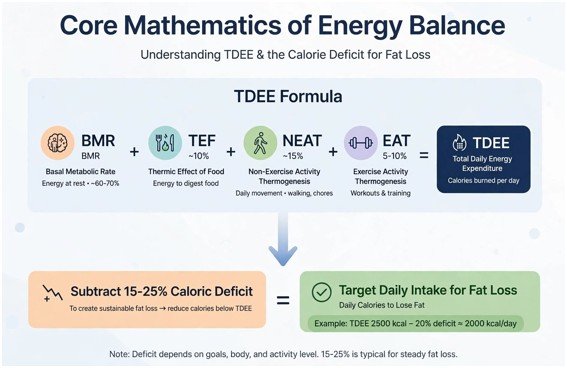
A calorie deficit occurs when your body expends more energy than it consumes, forcing it to metabolize stored adipose tissue for fuel. To find this number, you must calculate your Total Daily Energy Expenditure (TDEE)—the baseline number of calories burned in a 24-hour cycle. TDEE combines your resting metabolism, the energetic cost of digesting food, non-exercise movement, and deliberate workouts.

Your Basal Metabolic Rate accounts for roughly 60% to 70% of total daily burn. It represents the calories required to power cellular respiration, blood circulation, and organ function at absolute rest.
Through ongoing client tracking, I rely exclusively on the Mifflin-St Jeor formula. Clinical trials archived by the National Institutes of Health (NIH) show this equation predicts resting metabolic rate within 10% of laboratory indirect calorimetry:
To use pounds and inches, divide body weight in pounds by 2.2 to find kilograms, and multiply height in inches by 2.54 to determine centimeters.
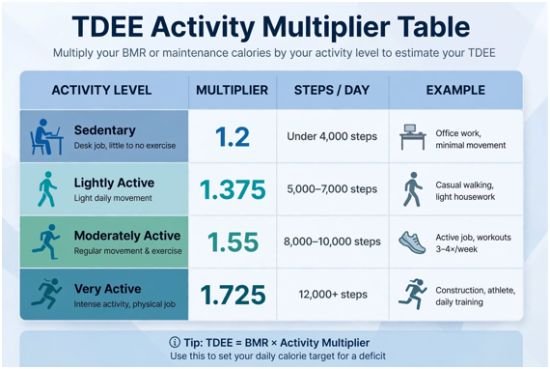
BMR covers survival, not movement. Multiply your BMR by an activity multiplier that matches your typical week:
| Activity Profile | Description | Multiplier |
| Sedentary | Desk job, under 4,000 daily steps, no planned training | 1.2 |
| Lightly Active | 5,000–7,000 steps, light training 1–3 days per week | 1.375 |
| Moderately Active | 8,000–10,000 steps, resistance training 3–5 days per week | 1.55 |
| Very Active | 12,000+ steps, heavy training or manual labor 6–7 days per week | 1.725 |
Most people overestimate their activity tiers. Unless you work on your feet all day, default to one tier lower than you assume. A desk worker lifting weights for 45 minutes four days a week usually functions best on a 1.375 factor, not 1.55.
Once you calculate maintenance calories, determine your reduction. A daily deficit of 500 calories mathematically yields roughly one pound of fat loss per week, aligning with standard clinical advice from the Centers for Disease Control and Prevention (CDC). However, fixed drops create problems across varying body weights.
[ Maintenance Intake: 1,600 kcal ] [ Maintenance Intake: 2,800 kcal ]
| |
-500 kcal Drop | -500 kcal Drop |
v v
[ 1,100 kcal / day ] [ 2,300 kcal / day ]
(Extreme 31% drop: RISKY) (Manageable 18% drop: SAFE)

Subtracting 500 calories from a 2,800-calorie maintenance level equals an 18% deficit, which is comfortable and spares metabolic rate. Subtracting 500 calories from a 1,600-calorie maintenance level forces a 31% deficit. That level of severe restriction crashes leptin, spikes ghrelin, and accelerates lean tissue loss.
Use percentages to anchor your individual weight loss goals:
Never drop calories below established clinical baselines without direct medical monitoring:
Research highlighted by Harvard Health Publishing demonstrates that crossing below these thresholds compromises micronutrient sufficiency, lowers bone mineral density, and elevates gallbladder strain.

Weight loss differs fundamentally from fat loss. Without structured macronutrient targets, up to 30% of lost weight can come from active skeletal muscle rather than body fat.
Target Daily Calories
|
+—————————-+—————————-+
| | |
v v v
[ Protein ] [ Fats ] [ Carbohydrates ]
1.6 – 2.2 g / kg 20% – 30% of Total Remaining Calorie Balance
(Satiety & Muscle Ret.) (Hormones & Lipids) (Glycogen & Performance)
Protein preserves muscle tissue, provides high satiety, and burns roughly 20% to 30% of its own caloric energy through digestion.
Dietary fat regulates testosterone, estrogen, and fat-soluble vitamin uptake:
Assign all remaining calories to carbohydrates:
CarbCalories=DeficitCalories-(ProteinGrams4+FatGrams9)
Carbohydrates replenish muscle glycogen, elevate thyroid hormone conversion, and sustain training intensity during resistance sessions.
Mathematical models assume your body behaves like a closed thermodynamic engine. Human physiology is adaptive. When energy intake drops, the subconscious nervous system lowers spontaneous movement—a biological shift known as NEAT suppression.
You might maintain identical gym sessions while fidgeting less, sitting more, and taking fewer unconscious strides. This adaptive response can reduce daily expenditure by 200 to 400 calories, neutralizing your planned deficit.
The American College of Sports Medicine (ACSM) emphasizes regular activity monitoring to counter this deceleration. Anchor your daily baseline by logging a consistent daily step count (e.g., 8,000 to 10,000 steps). If your weekly average weight plateaus for three consecutive weeks despite strict food tracking, reduce daily intake by 100 to 150 calories or add 1,500 daily steps to reopen the deficit.
Understanding these biological shifts is essential not just for cutting fat, but also to successfully maintain weight after losing it.
Yes, a 200-calorie deficit produces slow, sustainable fat loss of approximately 0.4 pounds per week while protecting muscle.
Chronic fatigue, poor sleep, muscle loss, constant coldness, and stalled gym performance signal an excessive deficit.
Yes, exercise increases energy expenditure, but tracking intake directly provides far more consistency than logging variable exercise burns.
Recalculate your deficit every time you lose 10 pounds (4.5 kg), because lower body mass decreases your resting BMR.
The calculator provides a launchpad; your biofeedback provides the direction. Pick a moderate 20% deficit, lock in your daily protein target, and hold your intake steady for 21 days without deviation. Track your morning body weight, assess your rolling seven-day average, and adjust based on real data rather than daily scale noise. Sustainable fat loss rewards precision over extreme restriction.













2 thoughts on “How to Calculate Calorie Deficit for Weight Loss: A Step-by-Step Method”